Average Reviews:

(More customer reviews)This book is one of the worst-organized books I've read on the topic of beekeeping. Conrad seems to be unable to put content on like topics together, so unless you sit down and read the entire book in one sitting, you will be hunting all over the place for information (with little help from the minimal index). For example: on page 50 he introduces the idea that an alternative brood nest arrangement is the use of a deep sandwiched by two shallows. Not until page 207 does he explain the benefits of this arrangement, and he never talks about other brood nest configurations, such as three mediums.
This is not unusual: information is scattered throughout the book with little or no regard to how the reader would approach it. In fact, Conrad seems to not be sure who his reader is: half the time he introduces a technical term without explanation, the other half he talks about it as if the reader were a beginning beekeeper.
The book is also filled with tortured language (he uses "mother," "queen mother," and "queen" interchangeably for "queen" in one section as if they meant the same thing) and digressions into his religion that would be less tiresome if there were any new information to be found among them. The information on hive management and honey harvest is very conventional, with extraction of honey from drawn comb and the continual re-use of comb from year to year (even though, by his own report, he ought to have learned his lesson from a lingering problem with AFB caused by this practise). If you were looking for information on more, well, natural forms of beekeeping like horizontal hives or top-bar hives, or beekeeping in conventional hives that comes closer to how feral hives like to operate, look elsewhere. There's a brief section on small-cell, but nothing at all about natural cell. Conrad doesn't seem to have ever even observed a feral hive in preparation for this book.
And if you are looking for a reference on the latest techniques in disease management for naturally managed hives, this is the wrong book. His summaries of the treatments and their benefits and drawbacks is cursory at best, and the information contained there could be found for free on the internet in much greater detail (and more clearly written). In addition, his citations can include such sleepers as a verbal report from somebody in his beekeeping club.
Even the information on operating a certified-organic apiary is pretty useless: the federal standards are explained more clearly on the USDA web site than Conrad seems to be able to do it. He can't seem to decide whether he's writing a long commentary or a manual of practice.
This book failed to provide me with any useful information on organic treatments for bee pests and diseases. Its focus on strictly conventional hive management was disappointing. The disorganized arrangement of information means that even if I wanted to use it as a reference I would spend half my time hunting for topics. A real disappointment.
Click Here to see more reviews about: Natural Beekeeping: Organic Approaches to Modern Apiculture
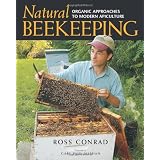
The various chemicals used in beekeeping have, for the past decades, held Varroa Destructor, a mite, and other major pests at bay, but chemical-resistance is building and evolution threatens to overtake the best that laboratory chemists have to offer. In fact, there is evidence that chemical treatments are making the problem worse. Natural Beekeeping flips the script on traditional approaches by proposing a program of selective breeding and natural hive management.Conrad brings together the best organic and natural approaches to keeping honeybees healthy and productive here in one book. Readers will learn about nontoxic methods of controlling mites, eliminating American foulbrood disease (without the use of antibiotics), breeding strategies, and many other tips and techniques for maintaining healthy hives. Conrad's reservoir of knowledge comes from years of experience and a far-flung community of fellow beekeepers who are all interested in ecologically sustainable apiculture. Specific concepts and detailed management techniques are covered in a matter-of-fact, easy to implement way.Natural Beekeeping describes opportunities for the seasoned professional to modify existing operations to improve the quality of hive products, increase profits, and eliminate the use of chemical treatments. Beginners will need no other book to guide them. Whether you are an experienced apiculturist looking for ideas to develop an Integrated Pest Management approach or someone who wants to sell honey at a premium price, this is the book you've been waiting for.
 Get 34% OFF
Click here for more information about Natural Beekeeping: Organic Approaches to Modern Apiculture

No comments:
Post a Comment